Middlesex County Guide

Middlesex County Historic Places

Explore Middlesex County’s historic villages, colonial crossroads, Rutgers landmarks, waterfront communities, and preserved sites from Cranbury, Woodbridge, New Brunswick, Perth Amboy, and South River.

A Historic Crossroads in Central New Jersey

Middlesex County sits at the center of New Jersey’s colonial, Revolutionary War, industrial, educational, and transportation history. This guide preserves the original NJTGO historic-place directory and presents it in a cleaner county guide format for visitors, residents, students, and local history researchers.

Colonial & Revolutionary Sites

Woodbridge, Perth Amboy, New Brunswick, and Cranbury all include early settlement, tavern, church, and crossroads stories tied to the colonial and Revolutionary periods.

Rutgers Historic Core

New Brunswick includes several Rutgers landmarks, including Geology Hall, Kirkpatrick Chapel, Van Nest Hall, Winants Hall, and Daniel S. Schanck Observatory.

County Cultural Heritage

The former Middlesex County Cultural and Heritage Commission is now represented through The Arts Institute of Middlesex County and its history, heritage, arts, and folklife programming.

Middlesex County Historic Places Directory

The listings below preserve the original NJTGO historic-place entries, with cleaned titles, corrected spelling where appropriate, and local image paths retained.

Visitor note: Historic markers, private properties, churches, university buildings, and museums may have different access rules. Always confirm hours, tour availability, parking, and public access before visiting.
Cranbury & Woodbridge
Cranbury Mills historic marker in Cranbury

Cranbury Mills

South Main Street and Evans Drive
Cranbury, NJ 08512

This gristmill stone commemorates Cranbury Mills, the first industry in Cranbury, erected by Thomas Grubbs in 1737 on the south side of Cranbury Brook. The original gristmill and dam helped create Brainerd Lake and supported the development of Cranbury Village around major early travel routes.

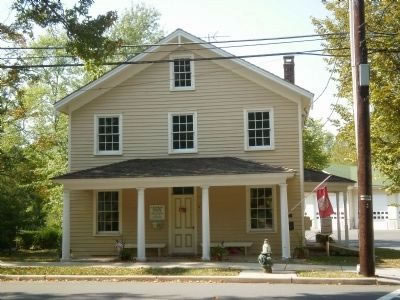
After multiple fires and rebuilds, the inactive gristmill was demolished in 1939 and the area became Memorial Park, dedicated in 1949 to Cranbury veterans of World War I and later wars. The former miller’s house at 6 South Main Street later became the Cranbury History Center.
Cross Keys Tavern historic marker in Woodbridge

Cross Keys Tavern

South James Street
Woodbridge, NJ 07095

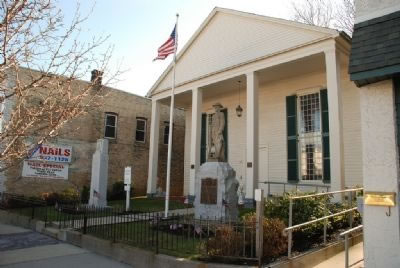
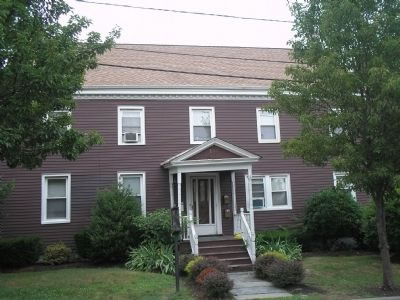
This tavern, operated by John Manning, hosted George Washington overnight on April 22, 1789, while he was traveling to his inauguration on April 30, 1789. Washington was accompanied from New Brunswick to Rahway by Captain Nathaniel Heard and militia from Woodbridge.

The tavern was originally located at the corner of Main Street and Amboy Avenue.

Trinity Episcopal Church historic marker in Woodbridge

Trinity Episcopal Church

Rahway Avenue
Woodbridge, NJ 07095

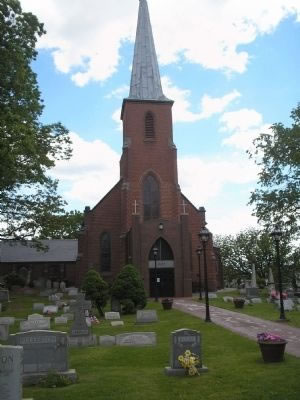
The first service was held December 29, 1703, by Rev. John Keith. The first church was erected about 1712, and a second church was built on the old site in 1754. The parish received a charter from King George III on December 6, 1769.

The second church was destroyed by fire in 1858. The cornerstone of the present church was laid July 7, 1860, and the church was consecrated May 20, 1861.

New Brunswick & Rutgers
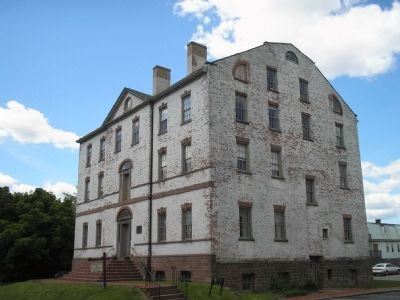
Buccleuch Mansion in New Brunswick

Buccleuch Mansion

George Street / Buccleuch Park
New Brunswick, NJ 08901

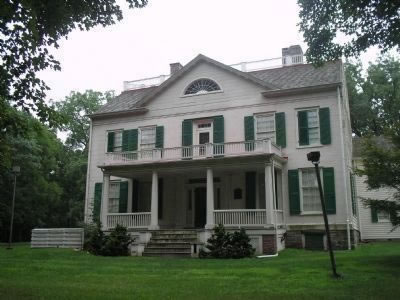
Built about 1735, Buccleuch Mansion was occupied until 1774 by Anthony White, whose wife Elizabeth was the daughter of Lewis Morris and whose son was General Anthony White. It was later owned by General William Burton of the British Army and by the Commissioners of Forfeited Estates during the Revolutionary period.

It was later associated with Colonel George Janeway, the Enniskillen Dragoons, Colonel and Commissary General Charles Stewart, John Garnett, and Colonel Joseph Warren Scott. Anthony Dey and family gave the house and land to the City of New Brunswick in 1911.

Buccleuch Mansion Info
Daniel S. Schanck Observatory in New Brunswick

Daniel S. Schanck Observatory

George Street
New Brunswick, NJ 08901

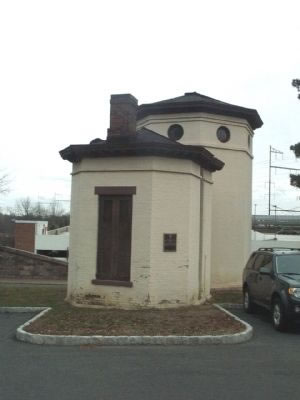
The Daniel S. Schanck Observatory is a two-story building with a revolving roof and rear wing connected by a passageway. Designed by Willard Smith, it was built to support astronomy study in the Rutgers Scientific School, established as a Rutgers College department in 1862.

The observatory was named for Daniel S. Schanck of New York City and dedicated on June 18, 1866.

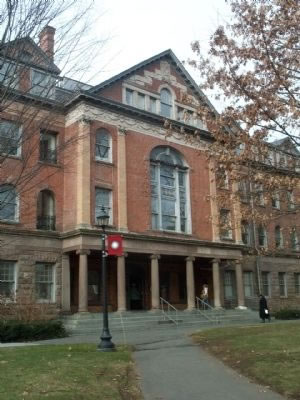
Van Nest Hall in New Brunswick

Van Nest Hall

Hamilton Street
New Brunswick, NJ 08901

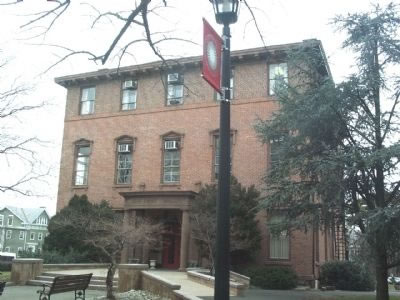
Originally two stories, Van Nest Hall was designed by Nicholas Wyckoff. Student literary societies Peithessophian and Philoclean occupied the first floor, while the museum and chemical laboratory of Lewis C. Beck filled the remainder.

The building was named for Abraham Van Nest, a New York merchant and Rutgers College trustee from 1823 to 1865. In 1893, the building was remodeled with a third floor and porch through the generosity of Ann Van Nest Bussing.

Geology Hall at Rutgers University

Geology Hall

Somerset Street and George Street
New Brunswick, NJ 08901

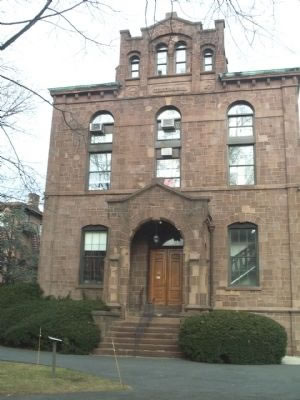
This brownstone building was designed by Henry Janeway Hardenbergh, a great-great-grandson of Rutgers’ first president. It served the departments of physics, military science, and geology.

The Rutgers Geology Museum has included important collections of minerals, fossils, Native American artifacts, modern shells, and a 10,000-year-old mastodon acquired by Professor George H. Cook in 1870.

Rutgers Geology Museum
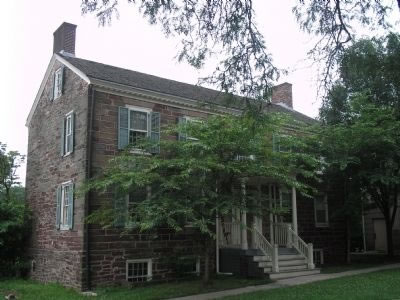
Henry Guest House in New Brunswick

Guest House

Livingston Avenue and Morris Street
New Brunswick, NJ 08901

Built by Henry Guest in 1760 of local stone, this house is remembered as a place where Thomas Paine once briefly stayed. It was relocated in 1925 and became an art center in 1940.

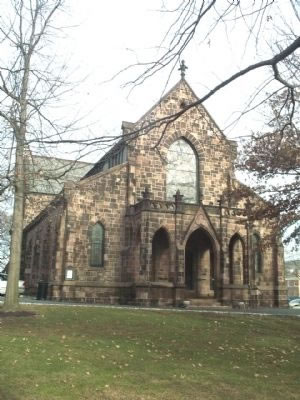
Kirkpatrick Chapel at Rutgers University

Kirkpatrick Chapel

Somerset and George Streets
New Brunswick, NJ 08901

Kirkpatrick Chapel was designed by Henry Janeway Hardenbergh and built as a chapel and library. The library was removed in 1903, increasing chapel seating from 300 to 600.

The chapel is named for Sophia Astley Kirkpatrick of New Brunswick, whose bequest financed the building. Its interior walls have traditionally displayed portraits of Rutgers presidents and other prominent Rutgers leaders.

Winants Hall at Rutgers University

Winants Hall

Somerset Street
New Brunswick, NJ 08901

Designed by architect Van Campen Taylor, Rutgers College Class of 1867, Winants Hall was Rutgers’ sole dormitory until 1914. It was named for Garret E. Winants, a Bayonne philanthropist who funded its construction.

In the late 1940s, the building was converted for university department and administrative office use. After a two-year restoration, Winants Hall was rededicated on November 9, 1990.

Perth Amboy & South River
Proprietary House in Perth Amboy

Governor’s House / Proprietary House

Kearny Avenue and Harrison Place
Perth Amboy, NJ 08861

Built by the colonial proprietors of East Jersey in 1762 with bricks brought from England, this house was first occupied by Frederick Smyth, Chief Justice of the colony. In 1774 it became the residence of William Franklin, New Jersey’s royal governor appointed by the Crown.

In 1809 it became a hotel called the Brighton House, when the south wing was added. During the Civil War, it was patronized by prominent Army and Navy officers.

Proprietary House Museum
St. Peter's Church in Perth Amboy

St. Peter’s Church — Oldest Parish in the State

Rector Street
Perth Amboy, NJ 08861

St. Peter’s is described as the oldest parish in the state, founded in 1698 when the Bishop of London sent Rev. Edward Portlock to serve as minister. Chartered in 1718 by King George I, it was used as a barracks for British troops in 1776.

Colonial governors attended service here. The first ordination to the ministry within New Jersey was held here in 1788, and several early diocesan conventions were held here between 1786 and 1816.

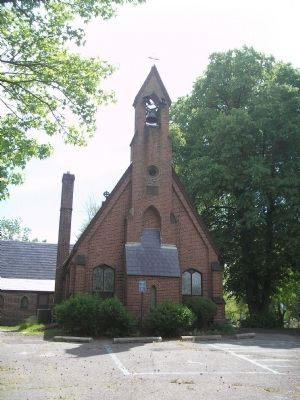
Old School Baptist Church in South River

Old School Baptist Church

Main Street
South River, NJ 08882

Built in 1805, the Old School Baptist Church is preserved in the original NJTGO historic directory as a South River historic landmark.

Planning Tips for Middlesex Historic Sites

Group by Area

For a day trip, group visits by area: Cranbury and Woodbridge; New Brunswick and Rutgers; or Perth Amboy and South River.

Check Public Access

Some landmarks are active churches, university buildings, or private / semi-public sites. Confirm tour rules and hours before planning a visit.

Use Transit-Friendly Hubs

New Brunswick and Perth Amboy are especially useful anchors for history trips because each has downtown access, transit, dining, and nearby historic points of interest.

Nearby Middlesex County Towns

Explore related Middlesex County town guides and communities near the historic sites listed above.